

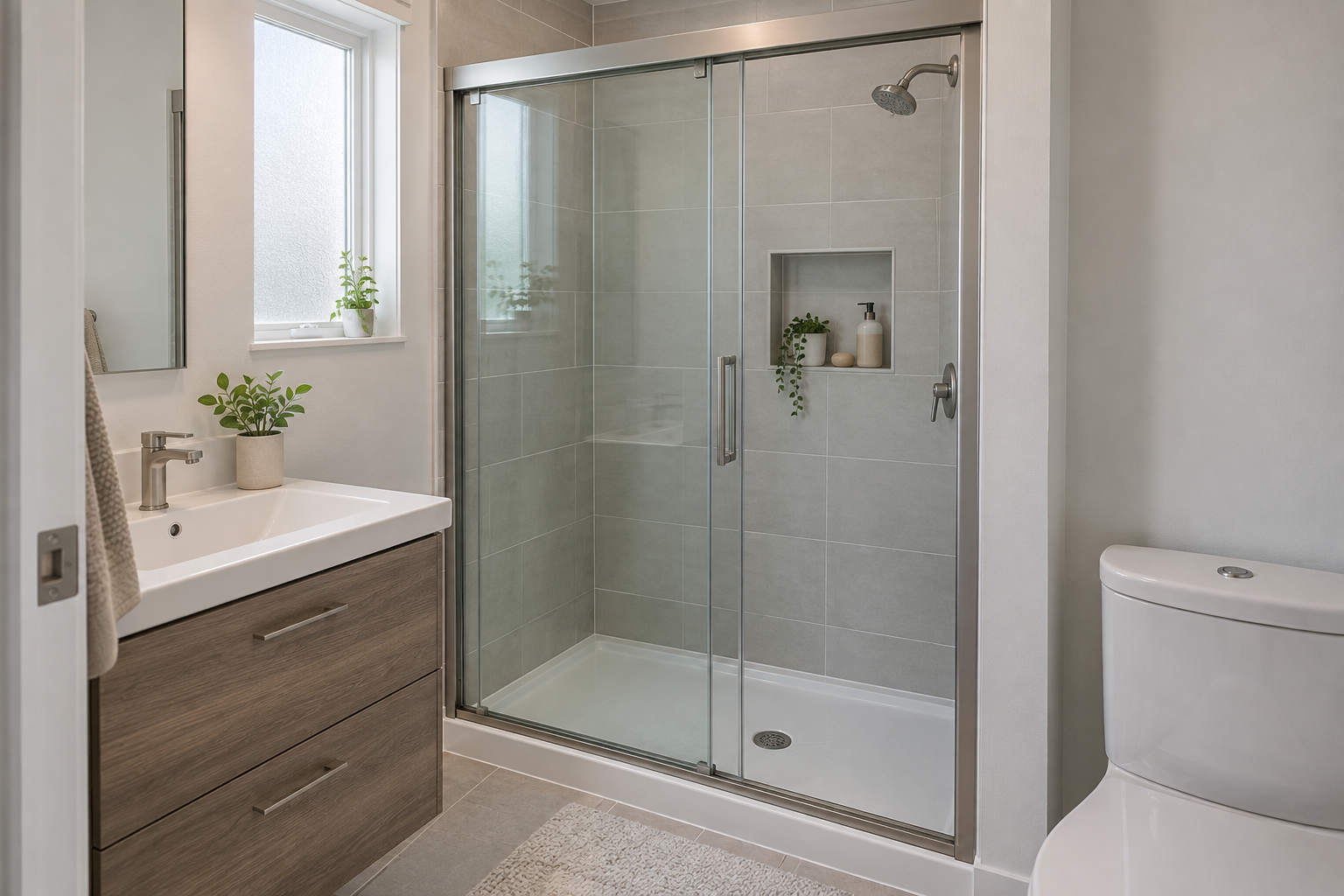
Guests are due in an hour, and you’re at the shower with a squeegee, chasing water spots off the clear panel. Then daylight from the window slides through the glass and across the tile, and the small room looks bigger than it did last week. That’s the quiet argument for glass shower doors. They turn a wet corner into part of the room.
Still, looks are only half the decision. Most shower doors are sold in sliding, hinged, pivot and frameless designs, and the frame, the glass thickness and the way the door moves decide whether you’ll enjoy it in year five. Here’s how to sort those choices when you’re updating a standalone shower and weighing budget framed models against pricier frameless ones.
Glass shower doors in framed, semi-frameless and frameless styles
Frame type is the first fork in the road, and it moves the price more than any other choice. A framed door wraps the glass in metal on every side, which makes it sturdy and forgiving on a budget. A frameless door shows almost no metal, just clean glass edges held by a few hinges or clamps. Semi-frameless models sit in between, keeping metal on some edges and dropping it elsewhere. Compare glass shower doors across all three and the price gap shows up here first.
Prices shift from one retailer to the next, so treat the three tiers as a rough ladder:
- Framed doors sit at the bottom of the ladder, the practical pick when you’re upgrading on a budget and want something durable.
- Semi-frameless doors land in the middle, giving you a lighter look without paying the full frameless premium.
- Frameless doors top the ladder, and the extra money buys a minimalist look and a seamless line into the room.
Top-tier models cost more and can be tricky to install, so the premium pays off mostly when the look is the point. If you’re refreshing a guest bath on a budget, a framed door is a perfectly sound answer. A cheaper door that fights you every morning isn’t a bargain, though, so judge it by how it opens as much as by how it looks.
The way the door moves matters too. Hinged doors suit larger bathrooms because they open wide, and pivot doors handle flexible layouts with easy access. Then there’s hardware. Matte black and polished chrome are the two finishes you’ll meet most often, so pick whichever one your faucet and towel bar already use. Mixing metals can look deliberate, but a matching set is the easier route.
Shower glass doors and how thickness, safety and daily care play out
Shower glass doors are commonly offered in 3/16″, 1/4″ and 5/16″ thicknesses. Thinner glass keeps the weight down, while the heavier options feel more solid every time you slide or swing them. With no metal border to steady the panel, a borderless door is a natural place for the heavier glass. Width plays into it as well, since a wide panel puts more load on its hinges or rollers.
Safety is the question people ask most. Frameless doors are made from tempered safety glass, which is built for daily use and, if it ever breaks, crumbles into small pieces instead of long shards. That matters in a room where you’re barefoot and wet.
Glass finish deserves a moment as well. Clear glass lets light travel through and keeps the room open, but it also shows every drop. A pattern hides spotting and adds some privacy, though it gives up part of that see-through effect.
Daily care is short work if you build it into the routine. Squeegee the glass after each shower, since regular cleaning is what stops water spots and buildup from settling in. Reach for a soft cloth and a non-abrasive cleaner, because scratches trap soap film. Once a week, wipe the bottom edge and the hardware, where water pools first and grime starts to collect. Do that, and the door stays clear for years. A well-fitted one also does its main job, keeping water inside the shower and off the bathroom floor.
Sliding shower doors for small bathrooms and tight clearances
Sliding shower doors solve a problem swing doors can’t. Think of a bathroom where the vanity or toilet sits a few inches from the shower, so a hinged door would hit it. A slider’s panels glide along a track, so nothing needs room to open into. That’s why sliders are the usual first suggestion for compact rooms and easy installation. With no swing arc to plan around, there are also fewer surprises on installation day.
Sliders come in generous sizes too. Common examples run from 48″ to 60″ wide at a 76″ height, with clear glass and matte black hardware, so a full-size alcove is well covered.
There are trade-offs. A slider opens only part of its width at once, so a 48″ opening leaves you roughly half of that to step through. The track needs an occasional scrub too, since soap scum loves a groove. If you only need a walk-in entry, a fixed 34″ x 76″ panel blocks splashes for far less money.
Tub-shower combinations follow the same logic on a smaller scale. Bathtub doors often run about 58″ tall instead of 76″, and they come as sliding or pivot models. A pivot door swings from a single hinge point, so check that the bathroom has room for the arc before you fall for one.
What to confirm before you order
Precision decides whether installation goes smoothly. Doors need exact measurements, and a quarter inch of error at the wall can mean a gap or a door that won’t close cleanly. Even a modest door goes wrong when the wall isn’t square, so it pays to check that before the box arrives.
Before you put anything in a cart, confirm these points:
- Opening width, measured at the top, middle and bottom, because walls are rarely perfectly plumb and the smallest number rules.
- Door swing or track clearance, so a hinged door won’t hit the vanity and a slider has room for its full run.
- Glass thickness and frame type, which together set both the price and how solid the door feels when you use it.
- Installation needs, including who’s doing the work, since the job can be complex and leaves little room for error.
Budget belongs on that list, too. A framed door is the budget upgrade, a slider is the easy install, and a frameless door suits a luxury bath that’s built around it. Whichever you land on, get the measurement right first and the price second.
Standard door widths run from 30″–32″ up to 47″–59″, so many typical alcoves fit a ready-made size. Odd layouts may call for a custom cut. For a look at how those sizes and finishes come together, Streamline GSRB’s range of shower doors is one place to browse before you commit.
Read more : Selling a Home Quickly: Simple Strategies

